
Humidity control is critical in cleanrooms and dry rooms. Yet moisture does not only enter through leaks or air infiltration. Vapor pressure diffusion also drives moisture migration through solid materials such as walls, ceilings, and floors.
Many facilities overlook this mechanism. However, it can significantly impact humidity stability, contamination risk, and energy consumption.
For engineers and facility operators, understanding vapor pressure diffusion helps explain why some cleanrooms struggle to maintain dryness even when the HVAC system performs correctly.
Understanding Vapor Pressure Diffusion
Water vapor naturally moves from areas of high vapor pressure to areas of low vapor pressure. This process is known as vapor pressure diffusion.
The concept is simple. If one side of a wall contains humid air and the other side contains dry air, moisture slowly migrates through the wall assembly. The driving force is the vapor pressure gradient between the two environments.
Unlike airflow driven infiltration, diffusion occurs even when the envelope is airtight. Moisture molecules move through microscopic pores in construction materials.
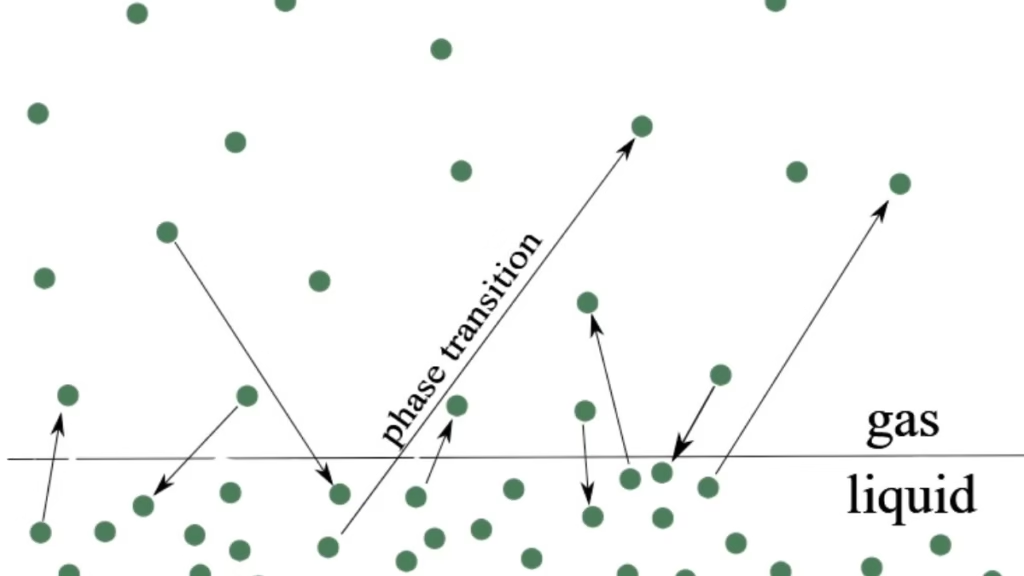
In controlled environments, the vapor pressure difference can be significant. For example, a typical building space may operate at 22°C and 50 percent relative humidity. Meanwhile, a pharmaceutical cleanroom or battery dry room may operate at much lower humidity levels.
The resulting vapor pressure gradient constantly pushes moisture toward the drier space.
Why Vapor Pressure Diffusion Matters in Cleanrooms
Cleanrooms rely on strict environmental control. Operators typically focus on airflow, filtration, and pressurization. However, moisture migration through diffusion can quietly destabilize the environment.
In dry rooms used for lithium battery manufacturing, the humidity target may reach extremely low levels. Even small moisture ingress can disrupt operations or damage sensitive materials.
Similarly, pharmaceutical cleanrooms often maintain tight humidity bands to ensure product quality and compliance with Good Manufacturing Practices.
If vapor pressure diffusion is ignored, moisture can accumulate inside walls or slowly enter the controlled space. Over time, this increases latent loads on the HVAC system and complicates humidity control.
The result may include unstable relative humidity, higher energy consumption, or condensation within building assemblies.
Vapor Pressure Gradient and Moisture Migration
The magnitude of vapor pressure diffusion depends on three main factors.
1- First, the vapor pressure difference between spaces. Larger humidity differences create stronger diffusion forces.
2- Second, the permeability of construction materials. Some materials allow vapor to pass more easily than others.
3- Third, the thickness and composition of the building assembly.
For example, gypsum board and concrete are moderately permeable. Meanwhile, materials such as aluminum foil laminates or specialized membranes act as strong vapor barriers.
In a poorly designed envelope, vapor diffusion can occur continuously across walls or ceilings. The controlled environment then becomes a moisture sink.
This phenomenon often explains persistent humidity drift in dry rooms.
The Role of Vapor Barriers in Cleanroom Design
To control vapor pressure diffusion, engineers typically incorporate vapor barriers into the building envelope.
A vapor barrier blocks or dramatically slows moisture migration. It prevents humid air outside the cleanroom from diffusing into the controlled environment.
In dry room facilities, the barrier often sits on the warm and humid side of the envelope. This placement prevents vapor from entering the extremely dry interior.
The concept resembles traditional building science principles. However, the stakes are much higher in controlled environments.
A small design mistake can introduce a continuous moisture load that the dehumidification system must remove.
Organizations such as the International Organization for Standardization publish guidance for contamination control in the ISO 14644 Cleanroom Standards series. While these standards focus primarily on particle control, environmental stability remains an essential part of compliant cleanroom operation.
Vapor Diffusion and Energy Consumption
Moisture diffusion does not only affect environmental stability. It also increases operating costs.
Every gram of moisture entering a dry room must be removed by the HVAC or desiccant dehumidification system.
Over time, diffusion driven moisture loads can become significant. The dehumidification system must run longer and consume more energy to maintain the target dew point.
In large battery manufacturing facilities, this hidden load can represent a major operating expense.
Engineers therefore treat envelope design as part of the humidity control strategy. The goal is to minimize uncontrolled moisture entry before relying on mechanical systems.
Integrating Envelope Design with HVAC Engineering
Effective humidity control requires coordination between architectural and mechanical design.
The building envelope must limit vapor diffusion. Meanwhile, the HVAC system must handle internal moisture loads from occupants, processes, and infiltration. This integrated approach often includes:-
- Proper vapor barrier placement within wall and ceiling assemblies.
- Continuous air sealing to prevent leakage pathways.
- Thermal insulation to prevent condensation inside assemblies. Careful design of penetration details such as pipes, ducts, and cable trays.
In many cases, envelope design decisions determine whether a dry room operates efficiently or struggles with chronic humidity problems.
This is why experienced cleanroom engineers evaluate vapor pressure gradients early in the project.
Practical Design Considerations for Dry Rooms
Battery manufacturing facilities present the most extreme case of vapor pressure diffusion.
Dry rooms often operate below minus 40°C dew point. The surrounding building environment may sit near 50 percent relative humidity.
This creates a massive vapor pressure difference. Without robust vapor barriers, moisture quickly migrates toward the dry room. Even tiny envelope defects can introduce measurable humidity loads.
Pharmaceutical cleanrooms usually operate at higher humidity levels. However, vapor diffusion can still influence stability when strict environmental tolerances apply.
Careful engineering and construction quality control are therefore essential.
Engineering Controlled Environments with Confidence
Vapor pressure diffusion may seem invisible, but its impact is real. Moisture migration through walls and ceilings can destabilize humidity control, increase energy consumption, and compromise facility performance.
Understanding this phenomenon allows engineers to design envelopes that work with the HVAC system rather than against it. At Cleanroom Catalyst, we approach controlled environment projects as integrated systems. Envelope design, airflow strategy, and dehumidification must work together from the earliest design stages.
If you are planning a new cleanroom or dry room facility, expert engineering makes the difference between stable performance and persistent operational challenges.
Learn more about our engineering and EPC services at
https://cleanroomcatalyst.com
Our team at Cleanroom Catalyst helps clients design, build, and optimize cleanrooms and controlled environments that perform reliably from day one.